
Space-Time

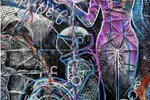
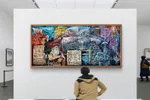
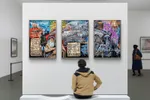
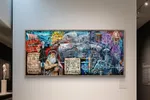
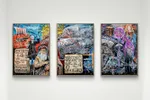
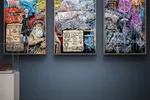
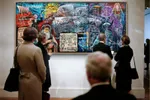
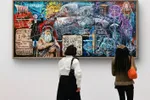

This painting would serve as a captivating centerpiece in a contemporary living room or study, inspiring conversation and contemplation. Its eclectic mix of themes makes it suitable for locations where creativity and intellect are valued, such as libraries, art studios, or modern office spaces.
General Review: "Space-Time" - An Allegory of the Visual Universe
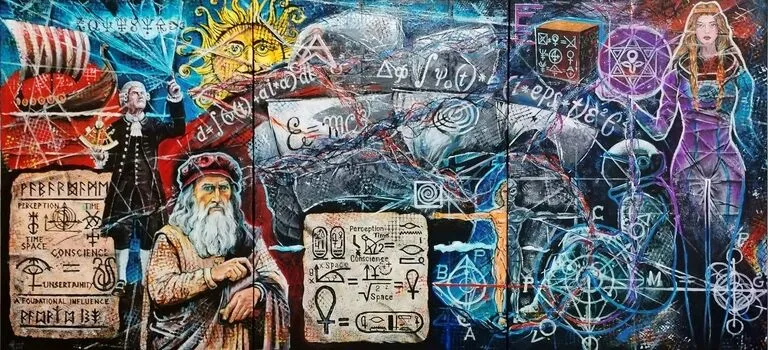
My artwork, titled "Space-Time," is more than a simple painting; it is an ambitious artistic and visual experiment, a profound synthesis of art, science, and philosophy. Through this piece, I've created a complex allegory of time and space, a visual meditation on how we perceive reality and the boundaries between human knowledge and cosmic mysteries.
The work is a multi-panel piece that, while distinct, unites into a coherent whole. The panels function like chapters, each exploring a different facet of reality, yet possessing a visual and thematic continuity that suggests a larger story, a "revelation" that lies beyond what is immediately visible.
This artistic experiment is distinguished by its unique approach, where I successively blended multiple styles, which I then reshaped and abstracted, integrating them with a final style. This method reflects the fundamental idea of the work: that time cannot be measured and perceived uniformly across different states and dimensions. I have translated this complexity of time, as described by scientific and philosophical theories, into an exploration of the artistic style itself.
The artwork incorporates a series of complex visual elements and symbols that create a deep resonance with its themes. Scientific theories, such as the Doppler Effect and Heisenberg's Uncertainty Principle, are integrated not just as simple concepts but as structural elements that influence the composition and visual dynamics. For example, the way colours seem to expand or compress in certain areas of the canvas can be a direct analogy to the Doppler effect, where the frequency (and colour of light) changes depending on the movement of the source. Furthermore, the exploration of concepts like space-time, messages from alien civilizations, and imagery inspired by series like Fringe and 1899 adds an extra layer of mystery and speculation.
Overall, "Space-Time" doesn't just illustrate scientific and philosophical ideas—it transforms them into a visual experience. It's an invitation for the viewer to become part of an experiment, to seek connections between the fragments of reality, and to contemplate the mysteries that unite them.
Panel 1 Analysis: "The Past" - The Roots of Knowledge
The first panel of my triptych, "The Past," is the cornerstone of the entire work. I conceived it as a dense visual landscape that anchors my artistic experiment in humanity's scientific and philosophical heritage. It's a synthesis of iconic figures, mystical symbols, and personal notes—an exploration of the very roots of knowledge.
In the foreground, I've placed two essential figures: Leonardo da Vinci and Isaac Newton. For me, their presence together is no coincidence; it's an analogy for how art and science have always been interconnected. Da Vinci, the universal man, symbolizes creativity and tireless research, a visionary who united anatomy, engineering, and art. He represents the roots of knowledge, a bridge between the distant past and future visions. Newton, with his instrument, is the portrait of the scientist who laid the foundations of classical physics, bringing order and precise laws to a universe previously perceived as chaotic. He symbolizes the crucial moment in the evolution of our perception of time and space, the moment when knowledge began to be defined by mathematical formulas.
At the top of the panel, I've integrated a Viking ship with sails above a medieval sun. This ship symbolizes exploration, a metaphor for humanity's journey through space and time, guided by curiosity and the desire to discover—a recurring theme in my work. The medieval sun, with its human face, represents a vision of the cosmos based on mythology and faith, a stage that preceded scientific understanding.
At the bottom, I've included a stone carved with a mysterious message. This stone, which contains a scheme of circles and symbols I created specifically for this work, is an allegory for a message from another world. It suggests that a part of our knowledge, much like in the series Fringe or the book "Memories of the Future”, comes from sources outside our world.
The handwritten elements on a sheet of what appears to be old paper add a personal and philosophical dimension. Here, I have visually connected key concepts like Perception, Time, Space, and Consciousness, suggesting that they are not separate entities but are interdependent. These handwritten notes are an analogy for Da Vinci's notebooks, emphasizing the idea of continuous research. The reference to Uncertainty directly below these concepts is a subtle nod to Heisenberg's Uncertainty Principle, suggesting that no matter how hard we try to define reality, a certain degree of ambiguity remains fundamental to our understanding.
In conclusion, "The Past" is an exploration of the origins of our knowledge. It is a panel that shows us how all discoveries, whether artistic or scientific, are interconnected and built upon the legacy left by the visionaries of the past.
Review of Panel 2: "The Present" - A Vortex of Knowledge and Energy
The middle panel of my triptych represents "the present"—a moment of constant transformation, a confrontation between classical theories and the realities of the modern world. Unlike the historical lines of the first panel, this is a vortex of energy, a field of visual forces where scientific knowledge, artistic intuition, and timeless symbols intertwine.
I wanted to show that the present is not a static point, but a continuous flow. I've used a multitude of mathematical formulas and symbols from physics to illustrate this. Einstein's emblematic formula, E=mc^2, is placed in the centre, a tribute to the theory of relativity that fundamentally changed how we perceive energy, mass, time, and space. Alongside it, I've included symbols like \int (integral) and \partial (partial derivative), which represent the mathematical language of the universe, a way to describe flow and change.
The dynamic, abstract lines that weave over the equations symbolize the energetic chaos and the fundamental complexity of reality. They are an allegory for Heisenberg's Uncertainty Principle—the idea that we cannot simultaneously know with absolute precision a particle's position and momentum. Similarly, in this work, the present is a point of tension, a place where scientific order meets the unpredictable and fluid movement of time.
I've brought back the sheet with my notes as a visual link to the previous panel. Here, however, it is represented as an Egyptian stone, a powerful visual element that underscores the idea that notions of time, space, and consciousness are as old as civilization itself. Ancient symbols, such as hieroglyphs and the Ankh symbol, representing life and immortality, are carved alongside modern concepts like perception, time, space, and consciousness. I wanted to emphasize that even as knowledge advances, our fundamental concepts remain the same. The formula I've included, \sqrt{2\cdot\frac{4}{\text{Space}}}, is a way to show how mathematical thinking can explore space and reality from a different perspective.
This panel is the "engine" of the artwork. It is the place where all forces—historical past, cosmic mysteries, and advanced scientific theories—converge. It creates a bridge to the final panel, allowing the viewer to feel the energy and potential that will explode into "the future."
Analysis of Panel 3: "The Future" - The Final Connection
This last panel, "The Future," is the culmination of my artistic experiment. After exploring the past and navigating the chaos of the present, I arrived at a future that is defined not by certainties, but by energy, consciousness, and limitless possibilities. This final canvas is an invitation to contemplate a realm where physics intertwines with spirituality.
At the centre of the composition, I placed an ethereal, glowing female figure who appears to be a messenger from another dimension. This figure, with her luminous outline, represents the future itself—a conscious entity that holds a higher knowledge. She holds a geometric sphere that pulses with an intense light, suggesting a new way of understanding reality—one that transcends known physical laws.
At the top, I included a floating cube covered with symbols. This is the message from other worlds that I created. The cube, a perfect form, represents a pure and ordered knowledge transmitted to us. It is a direct reference to the idea of interstellar communication and the exploration of concepts beyond Earth, a central theme inspired by movies like “Fringe”.
Around the figures and symbols, I created a network of dynamic, blue and red lines. This network is not just a visual element; it is an analogy to the Doppler Effect. The blue lines, which are approaching, suggest a rapidly moving energy toward the observer, a future that is drawing near. The red lines, which are receding, suggest an energy that is dissipating, a past that is fading, a transformation of matter into energy. This visual representation of the Doppler Effect anchors the future in the fundamental laws of physics, even as it explores it from a mystical perspective.
Overall, this panel completes the journey. I started with our scientific and artistic roots, moved through the chaotic present full of uncertainty, and arrived at a future that promises a higher synthesis of knowledge. The end of the work conveys exactly the feeling I wanted: that something beyond what we see is about to be revealed, that a new era of perception is imminent.
Curatorial Summary
Albert Deak’s “Space-Time” is a monumental triptych that traverses the arc of human knowledge—from mythic origins to quantum chaos to transcendent futures. Each panel functions as a chapter in a visual allegory, blending scientific theory, metaphysical speculation, and artistic intuition. Through layered symbolism, dynamic abstraction, and historical references, Deak invites viewers to contemplate the mutable nature of time, the role of perception, and the possibility of cosmic revelation. A rare synthesis of art, science, and philosophy, this work stands as a visual manifesto for a new era of understanding.
Size:
- Total dimensions triptych: 180 cm x 84 cm - (70.8 inches x 33.0 inches)
- Size of each panel: 84 cm x 60 cm - (33.0 inches x 23.6 inches)